Volcanoes and waterfalls, reef-fringed beaches and misty valleys—four main islands, each with its own rhythm, waiting to be woven into one unforgettable journey.
Photo: Roberto Nickson / Unsplash
We return to Hawaii again and again because no other U.S. destination packs so much contrast into such an easy hop from the mainland. One week can move from Waikīkī’s energy to a quiet Maui cove, then on to lava overlooks and Kauaʻi’s cathedral cliffs. The islands are culturally rooted, outdoorsy without needing to be extreme, and wonderfully suited to couples, families, and travelers who want to slow down. We love matching the right island—or mix of islands—to how you actually like to travel.
At a Glance
Hawaii is a true year-round destination, but each season shifts with the trade winds and the swell.
Our take: For whales, aim for January through March. For beaches and snorkeling, late spring through early fall is wonderfully forgiving. Either way, we build in flexibility for weather and ocean conditions.
The most complete single-island experience: Waikīkī energy, Diamond Head, North Shore winter waves, and a food scene that rewards curiosity. Ideal for culture, beaches, and easy logistics in one place.
A favorite for honeymoons and relaxed resorts, with soft leeward beaches, the Road to Hāna, Haleakalā, and winter whale watching. West Maui is welcoming visitors again after the 2023 wildfires; Lahaina is gradually reopening, though some streets and harbor-adjacent areas remain closed—we check access before every trip.
Twice the size of the other main islands combined, with Hawaiʻi Volcanoes National Park, black-sand beaches, coffee country, and starry high-altitude nights. Perfect for landscape drama and space to roam.
The lush “Garden Isle,” with the Nā Pali Coast, Waimea Canyon, and quieter resorts. Best for scenery, hiking, and a slower pace.
Smaller, quieter companions. Lānaʻi suits polished seclusion; Molokaʻi rewards a deeply local, unhurried feel. We usually suggest them as extensions once you know the main islands.
From the U.S. mainland, Hawaii is a domestic trip—no passport is required for U.S. citizens. Nonstop and connecting flights serve HNL (Honolulu, Oʻahu), OGG (Kahului, Maui), KOA (Kona, Island of Hawaiʻi), ITO (Hilo, Island of Hawaiʻi), and LIH (Līhuʻe, Kauaʻi). Short inter-island flights make hopping straightforward; many travelers add one or two so they wake up somewhere new without losing a full day.
Every arrival still includes an agricultural declaration: declare plants, fruits, vegetables, flowers, and animals on the in-flight form (or the state’s digital option on select flights), and present items for inspection in baggage claim. Hawaii takes biosecurity seriously, and we brief every traveler before departure.
Our classic approach: two or three islands over one or two weeks, with a relaxed pace between islands. Oʻahu plus Maui, or Maui plus Kauaʻi, are popular first combinations.
Beachfront stays with kids’ programs, easy snorkeling, and space for everyone from grandparents to toddlers. We look for strong family amenities and gentle ocean access.
Quiet resorts, spa retreats, and villa-style stays for honeymoons and milestone trips—often on Maui, Kauaʻi, or Lānaʻi.
Inter-island sailings let you unpack once and wake up at a new harbor. Round-trip Pacific cruises from West Coast ports suit travelers who prefer the ship as their hotel. We match the sailing to your pace and the islands you most want to see from the water.
Advisor tip: When you book through Novera Travel, we can often add Fora and Virtuoso perks at select hotels and resorts across the islands, such as daily breakfast, room upgrades when available, resort credits, and welcome amenities. Ask us which partners fit your trip.
The classic Honolulu pairing: a lively beachfront under the green cone of Lēʻahi. Standout experience: Reserve Diamond Head timed entry in advance (required for out-of-state visitors), hike to the summit, then cool off with lunch by the water.

Photo: Dai López / Unsplash
A protected crescent of reef on Oʻahu’s southeastern shore, and one of the islands’ most rewarding snorkel outings when calm. Standout experience: Book a reservation for an open day—normally closed Mondays and Tuesdays—and float above the coral after the required orientation.
Hanauma Bay fills the eroded crater of an ancient volcanic cone, its seaward wall breached by waves to create a sheltered, reef-lined bowl. Protected as a marine life conservation district since 1967, it is managed as a nature preserve, which is why visitors watch a short orientation before entering the water. Look for parrotfish grazing on coral, butterflyfish, Moorish idols and the humuhumunukunukuāpuaʻa, the reef triggerfish that is Hawaii’s state fish, and give resting green sea turtles plenty of room.
Oʻahu is also the best island for understanding Hawaii’s history. Kamehameha I unified the islands into a single kingdom in the early nineteenth century, and in downtown Honolulu ʻIolani Palace, home of the last Hawaiian monarchs, tells the story of the kingdom through its overthrow in 1893. Hawaii became a U.S. territory, then the fiftieth state in 1959. At Pearl Harbor National Memorial, the events of December 7, 1941, are remembered with quiet dignity, and timed reservations help visitors plan the day.

Photo: Kaydn Ito / Unsplash
Soft sand, usually gentler summer water, and sunset skies that linger. Standout experience: A slow beach day with an afternoon sail or a sunset drink overlooking the channel—simple, and hard to improve on.
Maui’s sunniest shores lie on its leeward west and south sides, in areas such as Kāʻanapali and Kapalua in West Maui and Wailea and Mākena to the south, where the island’s slopes block much of the trade-wind rain. Calm mornings are the time for snorkeling, before the afternoon breeze picks up. Just offshore, the partly submerged crescent of Molokini crater shelters clear, deep water rich with reef fish, and is a popular morning outing by boat.
In winter, the channels between Maui, Lānaʻi and Molokaʻi become a nursery for humpback whales that migrate thousands of miles from Alaska to breed, give birth and raise their calves in warm, shallow water. The area is part of a national marine sanctuary, and from shore you can often see breaches, tail slaps and spouts. If you snorkel or swim during the season, listen underwater: male humpbacks sing long, complex songs that can carry for miles.

Photo: Pascal Debrunner / Unsplash
Maui’s volcanic summit rises above the clouds, with crater vistas that feel otherworldly at dawn. Standout experience: Reserve sunrise vehicle entry well ahead, dress for near-freezing temperatures, and watch the light spill across the cinder cones.
Haleakalā means house of the sun, and legend says the demigod Māui climbed this mountain to lasso the sun and slow its journey so his mother’s kapa cloth could dry. The summit rises just over ten thousand feet, and the vast summit depression, often called a crater, was actually carved by erosion. Its cinder cones glow red, rust and gold, and on the slopes you may see the silversword, a rare plant found only here that blooms once in its life, and the nēnē, Hawaii’s state bird.
On the way down, linger in Upcountry Maui, a cooler world of farms, eucalyptus and ranchland. Kula’s volcanic soil grows sweet onions, vegetables, flowers and lavender, and the town of Makawao keeps alive the heritage of the paniolo, Hawaiian cowboys whose tradition dates to the 1830s, when Spanish-speaking vaqueros arrived to teach cattle handling. Rodeos, ranch tours and small bakeries give the area a relaxed character quite different from the beach resorts below.

Photo: Elise St. Clair / Unsplash
A winding East Maui drive of waterfalls, rainforest, and black-sand shoreline. Standout experience: Pace the day with a few chosen stops—and reserve Waiʻānapanapa in advance if the black-sand beach is on your list—rather than racing every overlook.
The Hāna Highway hugs Maui’s rainy windward coast, with hundreds of curves and dozens of narrow one-lane bridges between Kahului and the small town of Hāna. Along the way you pass bamboo groves, rainbow eucalyptus, waterfalls tumbling into swimming holes and roadside stands selling banana bread, fresh coconut and fruit. At Waiʻānapanapa State Park, a black-sand beach is framed by lava sea arches, caves and blowholes. Drive with courtesy, pulling over to let local residents pass, and park only in designated areas.
Hāna itself is unhurried and deeply rooted in Hawaiian culture, so the reward is less a sight than a feeling. Continue a few miles beyond town to the Kīpahulu District of Haleakalā National Park, where the Pīpīwai Trail climbs past giant banyan trees and through a towering bamboo forest to Waimoku Falls, which drops about four hundred feet down a sheer rock wall. Many travelers stay a night in Hāna so they can enjoy the road without watching the clock.

Photo: Zane Persaud / Unsplash
Home to Kīlauea, where the landscape is still being rewritten. Eruption viewing depends on current activity and is limited to designated overlooks; closed areas are off-limits. Standout experience: A guided afternoon into evening in the park, timed around glow, steam, or simply the vast caldera under the stars.
In Hawaiian tradition, Kīlauea is the home of Pele, goddess of volcanoes and fire, who is said to dwell in Halemaʻumaʻu crater, and offerings are still left there with respect. Kīlauea is one of the most active volcanoes on Earth, while neighboring Mauna Loa is the largest active volcano by volume and erupted most recently in 2022. In the national park, Crater Rim Drive, the Chain of Craters Road down to the sea and the Nāhuku lava tube reveal how new land is formed.
The rest of the island is just as varied. Mauna Kea, measured from its base on the ocean floor, is the tallest mountain on Earth, and its summit hosts some of the world’s leading observatories. Kona coffee grows on the slopes above the western coast, and evening snorkels off Kona offer a chance to watch manta rays feeding on plankton. On the east side, rainy Hilo has lush gardens and a lively farmers market, and green sea turtles bask on black-sand Punaluʻu beach.

Photo: Cedric Letsch / Unsplash
Kauaʻi’s northwestern cliffs are among the most photographed coastlines on Earth. Standout experience: See the coast by boat or a permitted trail approach; for Kēʻē Beach and the Kalalau trailhead at Hāʻena State Park, non-resident reservations are required.
The Kalalau Trail traces the Nā Pali Coast for about eleven miles to a remote valley once home to Hawaiian farming communities, and a permit is required beyond the first stretch to Hanakāpīʻai. Most visitors see the cliffs from the water or the air instead. In summer, calmer seas allow boats to slip close to sea caves, waterfalls and the fluted green ridges, while in winter the north swell often makes the coast too rough, a good reason to think about timing.
Often called the Grand Canyon of the Pacific, with red and green ridges that shift through the day. Standout experience: Drive the canyon lookouts, then continue to the Nā Pali overlooks if the weather is clear.
Waimea Canyon runs roughly ten miles long and plunges about three thousand feet deep, carved by rivers into layers of red, ochre and green volcanic rock. Above it, Kōkeʻe State Park offers cool upland forest, hiking trails and lookouts over the Kalalau Valley. Much of Kauaʻi’s water comes from Mount Waiʻaleʻale, the island’s central summit, which is among the rainiest places on Earth, feeding the waterfalls, rivers and lush valleys that earned the island its nickname.
Kauaʻi is the oldest of the main Hawaiian islands, and time and rain have given it the archipelago’s most sculpted landscapes. On the North Shore, the Hanalei Valley is a patchwork of flooded taro fields protected as a wildlife refuge for native waterbirds, while the south shore around Poʻipū is sunnier and drier. You will notice chickens everywhere, descendants of birds freed when hurricanes damaged farms in the 1980s and 1990s, a quirky part of the island’s easygoing charm.
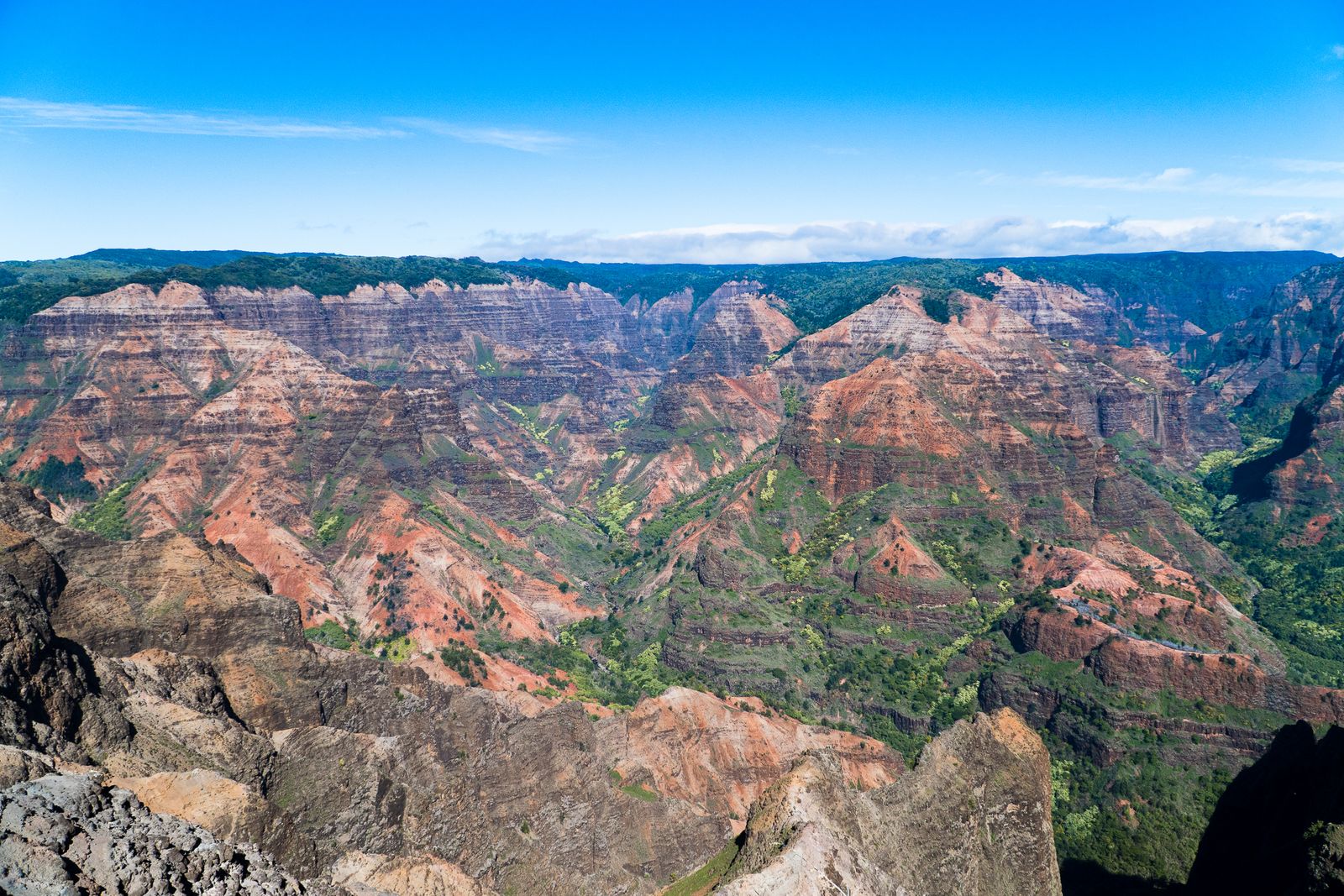
Photo: Vanessa Sezini / Pexels
Hawaiian culture is living, not a backdrop. We encourage travelers to move with aloha—warmth, respect, and care for people—and mālama ʻāina, caring for the land. Listen more than you speak at cultural sites, stay on marked trails, and treat sacred places with real reverence.
Flavors to try:
Reef-safe sunscreen is essential—Hawaii restricts the sale of formulas with certain reef-harming chemicals, and mineral options with zinc oxide or titanium dioxide are the responsible choice. Pack light layers, a rain shell for windward showers, and a warm jacket for a Haleakalā sunrise or Mauna Kea stargazing; summits can drop near freezing. Add water shoes, a reusable bottle, and smart-casual clothes for nicer dinners.
Year-round works. Choose winter for whales and big north-shore surf, or late spring through early fall for calmer swimming and typically drier weather.
No. Travel from the U.S. mainland is domestic. You will still complete an agricultural declaration on arrival.
One island suits a week; two islands fit comfortably in 10 days; three is realistic with about two weeks and well-timed flights.
West Maui resorts and many areas are open and welcoming visitors. Parts of Lahaina remain in active recovery with some streets closed. We verify access and recommend supporting open local businesses respectfully.
Yes—bring mineral reef-safe sunscreen. It protects you and the reefs, and it aligns with Hawaii’s sales restrictions on certain chemical filters.
It depends on current activity. When Kīlauea is erupting, viewing is from designated park areas only. We check the latest park and USGS updates before you go.
Whether you picture sunrise above the clouds on Haleakalā, a snorkel morning in a quiet bay, Kauaʻi’s cliffs from the water, or an easygoing multi-island escape, we will design a Hawaii journey around your pace and interests.
Novera Travel will be happy to arrange your international flights when you’re traveling first class.
Call +1 33 22 NOVERA – +1 (332) 266-8372 or email info@noveratravel.com
Prefer to reach out another way? Visit our Contact page.