Spice-scented souks, riad courtyards, camel treks into the Sahara and mint tea in mountain villages: our advisor’s playbook for a Morocco trip that feels effortless.
Photo: PhotoHound / Unsplash
Few places pack so much contrast into one trip. In a single week you can get lost in Fes’s thousand-year-old medina, sleep under Saharan stars and wake to snow-capped Atlas peaks. Morocco’s culture weaves together Amazigh (Berber), Arab, Andalusian, Jewish, African and French influences, and you’ll hear Arabic, Tamazight and French in a single afternoon. The Alaouite dynasty has ruled since the 17th century, and the country regained its independence in 1956.
Morocco rewards good planning: the right riad and a trusted driver turn a potentially overwhelming trip into an unforgettable one. This guide covers what we tell our own clients.
Our take: For a first trip that includes the Sahara, aim for April or October. In summer, focus on the coast and the mountains and keep desert time short.
Start in Casablanca, take the train to Fes, drive south through the Middle Atlas to Merzouga, then continue west via the gorges, Ouarzazate and Aït Benhaddou to Marrakech.
Combine Tangier, blue Chefchaouen and Fes; this route pairs well with a Spain trip.
For a shorter stay, base yourself in Marrakech, add a mountain lodge near Imlil and finish by the sea in Essaouira.
Trains: The national rail operator, ONCF, links Tangier, Rabat, Casablanca, Fes and Marrakech. Al Boraq, Africa’s first high-speed line, opened in 2018 and runs Tangier–Kenitra–Rabat–Casablanca, putting Tangier a little over two hours from Casablanca. Conventional trains continue to Marrakech and Fes. Book first class for reserved seats.
Private drivers: For the desert, the Atlas and Aït Benhaddou, a private driver is the way most of our clients travel. Distances are long, and a good driver doubles as a guide.
Why self-driving is less common: It’s legal, but medinas are car-free mazes, mountain roads such as the Tizi n’Tichka pass are winding, city traffic is chaotic and police checkpoints are frequent. Most travelers find a driver far less stressful.
What the 2030 World Cup means for you: Morocco co-hosts the 2030 FIFA World Cup with Spain and Portugal and hosted the 2025 Africa Cup of Nations, and the investment is visible. A high-speed extension from Kenitra to Marrakech, with a stop at Casablanca’s airport, was roughly a third complete in mid-2026 and is targeted to open in late 2029. Marrakech’s airport is also being expanded, so expect some construction there.
Getting there: Nonstop flights link Casablanca with the US East Coast, including New York. Most other Moroccan cities connect via Casablanca or Europe.
Confirm with the State Department and your airline before you go.
The US State Department’s advisory for Morocco is at Level 2, “Exercise Increased Caution,” due to terrorism (reissued September 4, 2026, with no change in level). Enroll in STEP and keep an eye on local news.

Photo: Markus Wagner / Unsplash
Riads: These traditional courtyard houses, many now intimate boutique hotels, are the heart of a Morocco stay. Expect a fountain or plunge pool, a rooftop terrace and attentive staff. Cars can’t reach most medina riads, so a porter usually meets you nearby. Palace-style resorts outside the medina suit families wanting space.
The word riad refers to a garden, and these houses were built to look inward: a plain wall on the lane hides a courtyard planted with orange trees and edged with rooms on two or three floors. Look for the craftsmanship that defines Moroccan interiors, from geometric zellige tilework and carved cedar ceilings to smooth, polished tadelakt plaster. Breakfast on the roof, with the call to prayer echoing across the medina, is unforgettable.
Luxury desert camps: At Erg Chebbi or beyond Zagora, private tented camps now offer en-suite bathrooms, real beds and candlelit dinners. Evenings typically end around a fire with drumming and songs, followed by a sky crowded with stars far from city light. In the village of Khamlia near Merzouga, families descended from sub-Saharan Africans perform Gnawa music, a hypnotic mix of chants, drums and iron castanets.
Trekking: Imlil offers village day walks and guided climbs of Jebel Toubkal, North Africa’s highest peak.
Culinary and craft: Cooking classes, market walks and artisan visits make easy half-days in Marrakech and Fes.
Advisor tip: Through Fora and Virtuoso, we can often secure added amenities at select riads, palace hotels and camps, such as breakfast, upgrades when available or a property credit.
The Red City’s medina centers on Jemaa el-Fnaa, a square that shifts from orange-juice stalls by day to smoky food grills, storytellers and musicians at night. Visit the 19th-century Bahia Palace and the cobalt-blue Majorelle Garden, where entry is by dated, timed tickets from the official website. Standout experience: Watch the square come alive at sunset from a rooftop terrace, then dive into the souks with a licensed guide.
The Almoravid dynasty founded Marrakech in the 11th century, and the city gave its name to the whole country in many languages. The Koutoubia Mosque’s 12th-century minaret still dominates the skyline, and the medina’s pink-red walls stretch for miles around the old city, a UNESCO World Heritage Site. Inside, the Ben Youssef Madrasa and the Saadian Tombs showcase intricate carved plaster, cedar and tilework. The Majorelle Garden was created by the French painter Jacques Majorelle and later restored by the designer Yves Saint Laurent.
The souks are loosely organized by trade, so you’ll pass from lanes of leather slippers to stalls of lanterns, carpets, spices and dyed wool. Try tanjia, a Marrakech specialty of beef slow-cooked in a clay urn in the embers of a hammam furnace. When you need a break, the Ourika Valley, the stony Agafay desert and the foothills of the High Atlas are all within easy reach for a day trip.

Photo: Riccardo Monteleone / Unsplash
Fes el-Bali is a vast, car-free, Unesco-listed maze of madrasas and workshops. The leather tanneries, with their honeycomb of dye pits, are best viewed from a neighboring terrace in the morning. Standout experience: A full day with a licensed guide, from the Al-Attarine Madrasa to the tanneries.
Fes was founded at the end of the 8th century by the Idrisid dynasty and became a great center of learning and trade. The University of al-Qarawiyyin, founded in 859 by Fatima al-Fihri, is often described as the oldest continuously operating university in the world. In the 13th century the Merinid sultans built a new city, Fes el-Jdid, beside the old one, including the mellah, the historic Jewish quarter, and the beautifully decorated Bou Inania Madrasa.
Fes is the place to see Moroccan crafts made by hand, from brass engraving and zellige tile-cutting to leatherwork and weaving. The tanneries still use traditional techniques and natural dyes, and the smell is part of the experience. Fassi cooking is known for its refinement, especially sweet-and-savory pastilla. A day trip takes you to the Roman ruins of Volubilis and the imperial city of Meknes, built up in the 17th century by Sultan Moulay Ismail.

Photo: Nichika Sakurai / Unsplash
This mountain town in the Rif is painted in every shade of blue. Stay overnight so you can enjoy the lanes after day-trippers leave. Standout experience: Walk up to the hillside Spanish Mosque for sunset over the blue rooftops. Founded in 1471 as a fortress, the town later welcomed Muslim and Jewish refugees from Andalusia, whose influence shows in its whitewashed and tiled architecture. Nearby, Talassemtane National Park offers hikes to waterfalls and a natural rock arch. Chefchaouen is also known for its soft goat cheese and woven wool blankets.

Photo: Taisha Ellison / Unsplash
The towering dunes of Erg Chebbi near Merzouga are the classic Sahara image. Zagora is closer to Marrakech, with smaller dunes and palm-lined valleys. Standout experience: A sunset camel ride into the dunes, a night in a desert camp, then sunrise from a ridge. Erg Chebbi’s sand sea rises in sculpted ridges that change color from gold to orange to rose through the day, and the oasis towns around it grow dates and grain beside ancient irrigation channels. To the southwest, the Draa Valley leads to Zagora through palm groves and earthen kasbahs, past the famous sign recalling the camel caravans that once took 52 days to reach Timbuktu.
An hour or two from Marrakech, Amazigh (Berber) villages cling to terraced valleys below Toubkal. Earthquake recovery: The September 2023 Al Haouz earthquake hit this region hard. As of a March 2026 government update, more than 54,000 homes had been rebuilt and nearly all targeted tourist accommodations rehabilitated, while road, bridge and heritage work continues. Imlil is welcoming visitors, and staying in locally owned guesthouses supports the recovery. Standout experience: A guided village walk ending with lunch and mint tea in a family home.
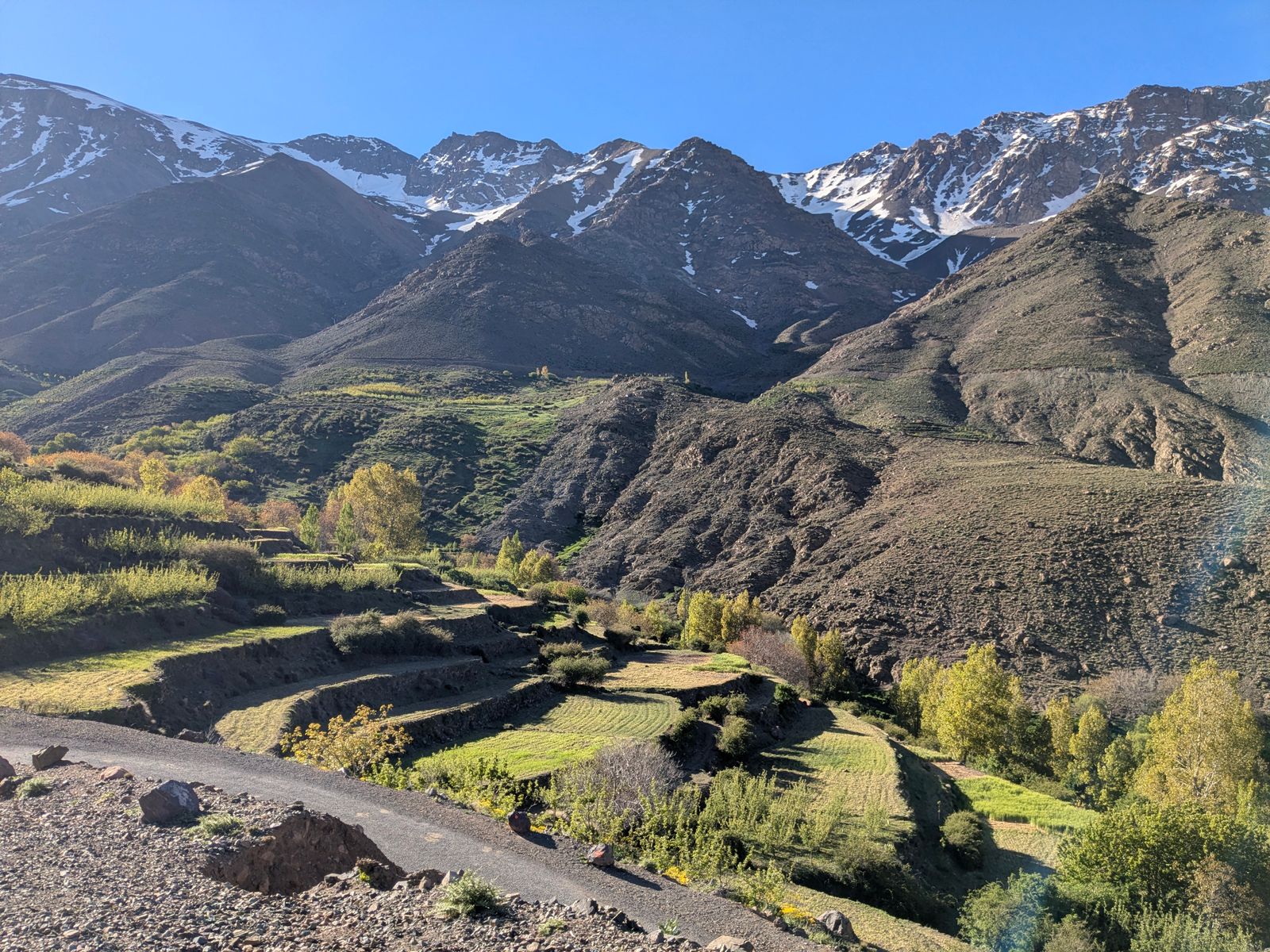
Photo: mouad simou / Pexels
Aït Benhaddou is a Unesco-listed earthen ksar on a caravan route, familiar from many films. Nearby Ouarzazate is the gateway to the Dades and Todra gorges. Standout experience: Climb to the granary at the top of the ksar in late-afternoon light.
Built of rammed earth and mud brick, Aït Benhaddou’s tightly packed houses and towers climb a hillside above a river, and a few families still live within its walls. It was listed by UNESCO in 1987 as a striking example of southern Moroccan earthen architecture. East of Ouarzazate, the road follows a chain of oases sometimes called the Road of a Thousand Kasbahs, through the palm groves of Skoura and the Valley of Roses, which holds a rose festival each spring.
A whitewashed, windswept port with a Unesco-listed medina and a blue fishing fleet. Standout experience: Watch the fishing boats come in, then eat freshly grilled seafood by the harbor. The trade winds that blow here most of the year make Essaouira a favorite for kitesurfing and windsurfing, and they keep the town cooler than inland cities in summer. Its 18th-century medina was laid out for the sultan by a French engineer, and the town hosts a well-known Gnawa music festival.
The Hassan II Mosque, built partly over the Atlantic, is one of the few mosques in Morocco open to non-Muslims, and only on guided tours run by the mosque’s foundation. Tours run most days at set times outside prayer, with a reduced schedule on Fridays and during Ramadan. Dress modestly, remove your shoes, and stay with your group. Rabat, the calm capital, offers the Kasbah of the Udayas, the Hassan Tower and the Mohammed V Mausoleum. Standout experience: A morning mosque tour, then lunch on Casablanca’s corniche.

Photo: Fahad Al Rabbani Jillani / Unsplash
Long a magnet for writers and artists, Tangier looks across the Strait of Gibraltar to Spain. Standout experience: Sunset at Cap Spartel, where the Atlantic meets the Mediterranean.
From 1923 until Moroccan independence, Tangier was an international zone governed by several foreign powers, which drew diplomats, artists and writers. Henri Matisse painted here, and the American writer Paul Bowles made it his home for decades. The whitewashed kasbah crowns the hill above the medina, and the city’s cafés, gardens and terraces look out across the Strait toward Spain, just a short ferry ride away. Nearby, the small seaside town of Asilah is known for its murals and art festival.

Photo: HamZa NOUASRIA / Unsplash
Food: The slow-cooked tagine comes in endless versions, from chicken with preserved lemon and olives to lamb with prunes. Friday is traditionally couscous day. Pastilla is a flaky pie filled with pigeon or chicken, almonds and cinnamon. Sweet mint tea is poured from a height as a sign of welcome; accepting a glass is polite. Alcohol is served in licensed hotels and restaurants.
Hammams: Traditional bathhouses are separated by gender. A local hammam is lively and simple, while a spa hammam offers private rooms with black-soap scrubs and argan oil treatments.
Modest dress: Cover your shoulders and knees, especially in medinas, villages and religious sites.
Ramadan: During the holy month, many Moroccans fast from dawn to sunset. Avoid eating, drinking or smoking in public during daylight, and expect shorter hours at some sites. Evenings are festive, and joining an iftar meal is a highlight.
Haggling: Bargaining is expected in the souks. Keep it friendly, start only if you’re genuinely interested, and walk away politely if it doesn’t feel right.
No, not for tourism stays of up to 90 days. Your passport should be valid for six months on arrival, with a blank page.
The State Department rates Morocco Level 2, “Exercise Increased Caution.”
Most active mosques are closed to non-Muslims, but Casablanca’s Hassan II Mosque welcomes visitors on guided tours.
Yes. Imlil and the Toubkal area are welcoming visitors, and tourism supports the recovery. Some reconstruction continues in remote villages.
The right riads, a trusted driver and a dreamy desert camp: planning all that is our specialty. As Fora travel advisors with IATAN accreditation and Virtuoso affiliations, the Novera Travel team can match you with the right riads and hotels, find added amenities on select stays, and arrange private guides, drivers, trains and desert camps throughout Morocco.
—
Novera Travel will be happy to arrange your international flights when you’re traveling first class.
Call +1 33 22 NOVERA – +1 (332) 266-8372 or email info@noveratravel.com